The WhitePaper Reading Club NYC [2] - X402 Protocol:Open HTTP Payment Standard by Othman(OCC Research), Lincoln (Coinbase) 13 Aug 2025
Summary
x402 is an open protocol for embedding instant stablecoin payments directly into HTTP requests using the 402 Payment Required status code (a http protocol code). Enables user-to-machine & machine-to-machine micropayments for APIs, web content, and agents without accounts, subscriptions, or intermediaries.
Why This Is Important
Current payment rails make specific global, permissionless monetization impractical. Credit card and bank payments have high fixed fees, slow settlement, and require personal information, incompatible with autonomous AI agents or sub-cent transactions. x402 removes this friction by letting any HTTP server demand and verify a crypto payment before returning a resource. It opens monetization of the “long tail” of services which represent a large untapped market.
Overview
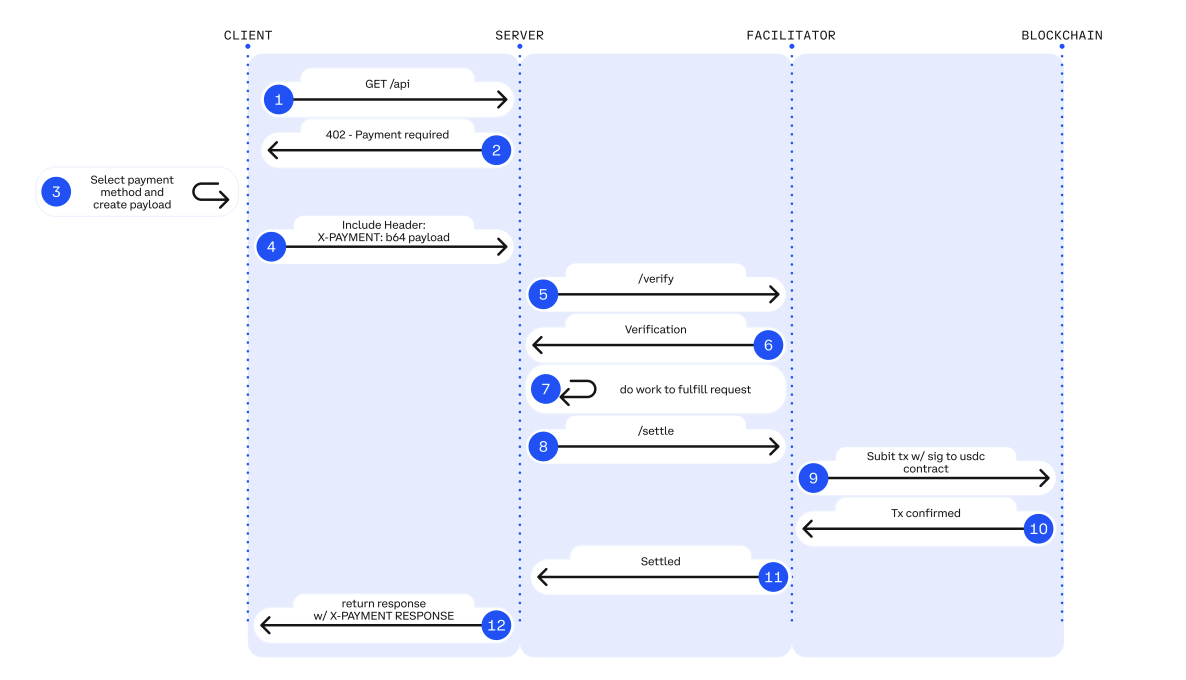
The design of the protocol abstracts away blockchain complexity for developers and end-users, letting web payments feel like native HTTP. Development is stablecoin-focused because that allows for price stability as USDC is the default token utilized on low-fee chains. x402 can work on multiple blockchains, supporting off-chain transfer authorization, making it a chain agnostic protocol. The facilitators are optional and are responsible for offloading blockchain I/O, compliance checks, and settlement from the resource server. x402 uses the existing HTTP infrastructure to request payment. A resource server responds with 402 Payment Required + JSON payment requirements (price, accepted token, recipient address, chain). The client signs a payment payload (e.g., USDC transferWithAuthorization) and retries the request with the signed data in an X-PAYMENT header. The server or an optional facilitator verifies the signature, submits the transaction on-chain, and returns the resource.
Team
The Coinbase developer platform (CDP) is comprised of different leadership personnel in Coinbase. Erik Reppel is the head of engineering. Ronnie Caspers is a senior product manager. Kevin Leffew is the GTM lead for the Coinbase developer platform, and Danny Organ handles product marketing. Collaborators include AWS, which may explore cloud and API integration; Anthropic, integrating x402 into its AI agent frameworks (MCP); Circle, the issuer of USDC and key stablecoin partner; and NEAR, showcasing x402 with its NEAR Intents for cross-chain payments. Early adopters in the community range from Chainlink, XMTP, and Cal.com to Hyperbolic and independent developers implementing and experimenting with x402 on chains like XDC.
Components
| Payment Flow | 402 Response – HTTP challenge containing Payment Requirements JSON.Signed Payment Payload – cryptographically signed authorization to transfer a specific amount to a recipient.X-PAYMENT Header – client resends the request with a signed payload here.Verification & Settlement – server or facilitator verifies signature and executes on-chain settlement.X-PAYMENT-RESPONSE – confirms transaction and grants resource. |
|---|---|
| Client(Buyer) | (i) Initiates requests to access paid resources (ii) Processes 402 responses and extracts payment details (iii) Submits payment with the X-PAYMENT header |
| Server(Seller) | (i) Defines payment requirements with HTTP 402 responses (ii) Verifies incoming payment payloads (iii) Provides the requested resource once payment is confirmed |
| Facilitator | (i) Offloads signature verification, blockchain broadcasting, confirmation polling, and (optionally) KYT checks. (ii) Can be Coinbase-hosted or self-hosted. (iii) Verifying payment payloads (iv) Settling payments on the blockchain for servers (v) Removing the need for servers to implement complex blockchain interactions |
| Middleware | (i) Drop-in code for frameworks (Express.js, Flask, etc.) that intercepts requests, checks for valid payment, and triggers the 402 error code if payment is missing. Questions: Are these managed by facilitators or the companies themselves? |
| Tokens & Chains | (i) Defaults to USDC on low-fee/high-speed chains (e.g., Base, Solana, NEAR). Extensible to ERC-20s and chains with off-chain authorization methods. |
| Use Cases | (i) Per-API call billing. (ii) Per-article/content micro-paywalls. (iii) AI agents autonomously paying for compute/data. (iv) IoT devices paying per data packet. |
| --- | --- |
Opinions
- Protocol merit: Clever use of a dormant HTTP status code to create a universal paywall primitive. Could meaningfully shift web monetization from ads/subscriptions to direct micropayments.
- Middleware centralization risk: Although the spec is open, Coinbase’s reference middleware defaults to their facilitator. Most early devs may adopt this without customization, giving Coinbase soft control over everything that flows through the protocol
- Facilitator incentive gap: Unlike routing nodes in Lightning or validators in PoS chains, x402 facilitators have no built-in, protocol-level economic rewards. Unless resource servers voluntarily pay them, there’s little incentive for independent facilitators to spin up, making it likely most traffic defaults to Coinbase’s hosted service by convenience. This undermines the protocol’s decentralization potential despite facilitators being “optional” in theory.
- Compliance exposure: Making facilitators optional means resource servers can run fully self-hosted verification/settlement without KYT or sanctions screening, opening potential non-compliant payment channels
- Authentication caveat: x402 “authenticates” that the sender controls funds, not that they are legitimate or KYC’d. If those tokens were obtained via hacks or exploits, the system still considers them valid.
- Business model implications: Lowers monetization friction for the long tail by allowing small creators/developers charge without intermediaries and having to harvest data for ad revenue, but also makes it easy for big players to meter every micro-interaction, potentially fueling hyper-capitalist value extractive models.
Glossary
| KYT: Know Your Transaction; checks for sanctioned or illicit addresses. | Off-Chain Authorization: Signing a token transfer payload without sending it immediately on-chain. | Middleware: Code layer between HTTP requests and core application logic that enforces payment rules. | Facilitator: Service that handles blockchain interactions and compliance checks on behalf of the resource server. | 402 Payment Required: Reserved HTTP status code used as a payment challenge |
|---|
References
- x402 Whitepaper - https://www.x402.org/x402-whitepaper.pdf
- Coinbase Developer Docs – https://www.coinbase.com/developer-platform
- Coinbase Blog – https://www.coinbase.com/developer-platform/discover/launches/x402
- QuickNode - https://www.quicknode.com/guides/infrastructure/how-to-use-x402-payment-required