The WhitePaper Reading Club Singapore [20]
Story Protocol (SP) World’s IP Blockchain 27 Aug 2024
Redefining IP Management on the Blockchain Dustin (Eth65), Shoham (Eth Core), Yovie (Herring), MUNG (DaoLayer ,Wenyi(Spartan), Vincent, Kathy, Rongxin
Summary
Story is a platform that puts Intellectual Property on chain (RWA) and makes it programmable and usable in new ways.
Why This Is Important
Part of tokenizing everything in the world, allowing people to use, remix or extend an IP, creating new projects, tools, and/or revenue sources. It can also help to connect existing legal contracts with Digital Blockchain “Contracts”
Overview
Story is a blockchain protocol that allows creators to register their intellectual property so they can track and monitor use, ensuring their legal and economic rights are protected. This means that creators of original content are rewarded, no matter how their content gets used and distributed. Meanwhile, licensing IP becomes low friction and standardized, encouraging widespread sharing and collaboration. The goal is to create foundational infrastructure that can underpin a new economic covenant between creators and platforms.
Background
(i) IP is stuck in an outdated, costly system that benefits few; most IP is illiquid and inaccessible. It is also threatened by the rise of AI-generated content as akttribution is increasingly difficult; a tragedy of the commons. As digital assets grow, and increasingly replace physical ones, a modern solution is urgently needed.
Team
Seung Yoon “SY” Lee is the CEO and co-founder of Story Protocol. In 2021, SY sold his mobile fiction app Radish to Kakao for $440M and became their Global Strategy Officer at Kakao Entertainment. He is also a venture partner at Hashed, a Forbes 30 Under 30 Asia alum, and was the first Asian President of the Oxford Union. Jason Levy is the COO and co-founder. He was a Director at Pocket Gems, and led content for Episode, a top storytelling app with 200M+ downloads and $100M+ revenue. He’s also an ex-Apple financial analyst, Stanford MBA, and USC Renaissance Scholar. Jason Zhao is the Head of Protocol and co-founder. Formerly a Product Manager at DeepMind, he’s an angel investor and founder of Stanford Rewired. Zhao holds a Bachelor’s in Philosophy and a Master’s in Computer Science from Stanford. Investors: Recently raised $80M in Series B led by a16z, with participation from Endeavor, Hashed, dao5, Samsung NEXT, 11:11 Media, Roham Gharegozlou (Dapper Labs CEO), Charlie Songhurst (Former Microsoft Head of Strategy), Two Small Fish, Balaji Srinivasan (Former Coinbase CTO), Bang Si-hyuk (HYBE Chairman), CH Kim (KRAFTON CEO), and David Bonderman (TPG Capital Founder).
Opinions
(i) Incredibly important concept and product—this is much needed in the evolving digital landscape. (ii) The product seems promising, but usability/product appears light. They still need developers to build on their platform and it’s still early days. But the expectation is large considering a 150M+ raise. Can they create a valuable business that does not completely rely on a native token? (iii) The main challenge is that most existing IP is controlled by large, traditional entities. Success hinges on attracting and fostering new IP generation and development (iv) There’s a lack of info on the technical side, especially regarding why they opted to build a separate blockchain and how Cosmos fits into their strategy.
Community
Discord: A cesspool of moderators who are just creating “vibes”, and don’t really know wtf is happening.
Competitors
Music Protocol, Audius, Lens Protocol, Flow
Conceptual Components
| Programmable IP License [PIL] (Universal License Agreement) | (Legal Contract) Similar to YC’s SAFE, Programmable IP License (PIL) is a customizable, universal license that bridges real-world IP with its on-chain tokenization. Similar to how fiat backs USDC, PIL secures IP on the blockchain, enabling easy, permissionless licensing and commercialization. It integrates closely with Story’s smart contracts, enforcing terms transparently and autonomously. Creators can set and attach PIL terms to their IP assets, making the process seamless for both Web3 and Web2 services. Note: Inspired by Cornell Prof James Grimmelman’s Token-Bound NFT License (link, REF 2) |
|---|---|
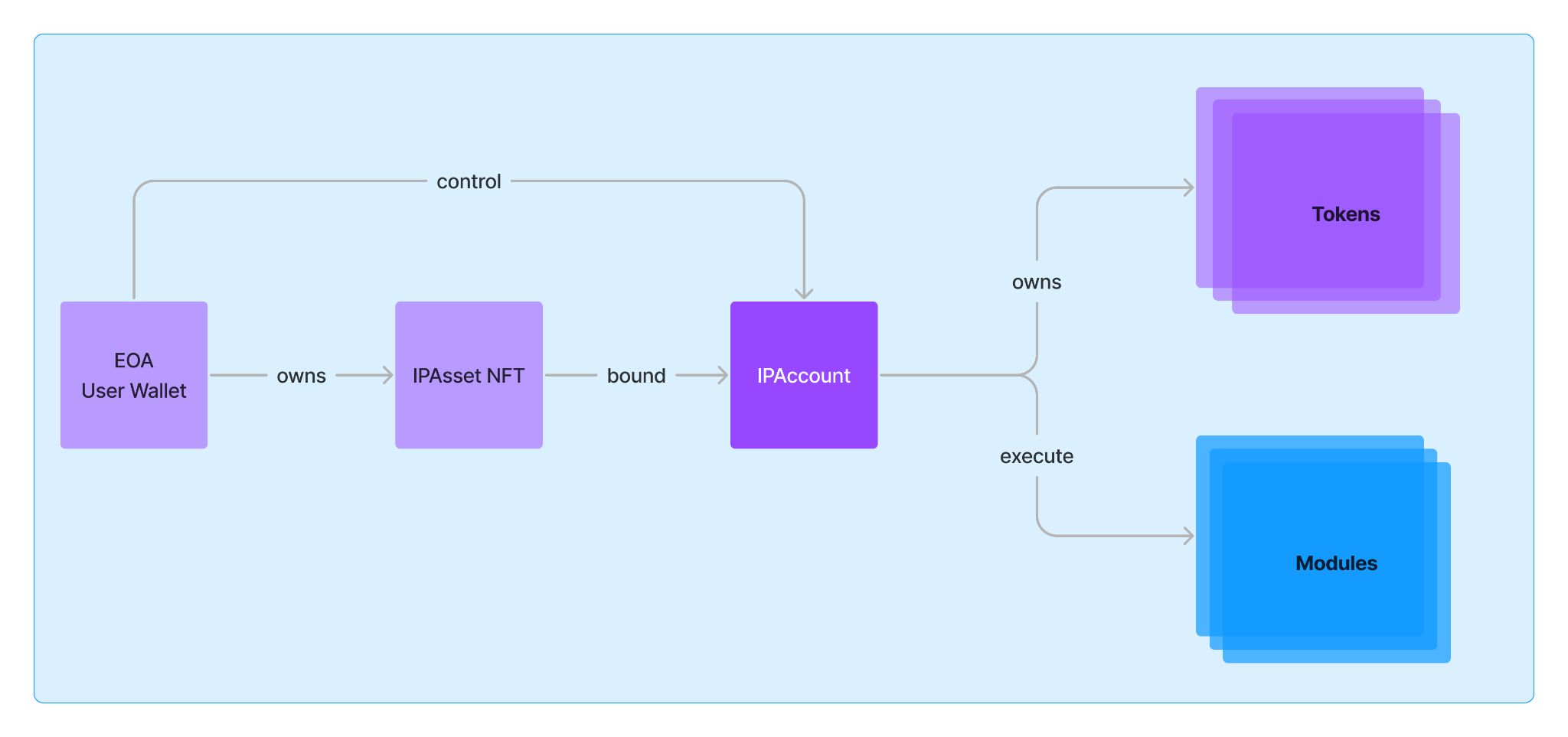
| IP Asset | The core programmable IP metadata on Story is an on-chain ERC-721 NFT. Existing NFTs like Azuki or Pudgy Penguin can register directly, no wrapping is needed. For off-chain IP, you first mint an ERC-721 NFT, then register it as an IP Asset. Each IP Asset has an associated IP Account, a modified ERC-6551 contract, which controls permissions and stores related data. |
| IP Account | A contract that gives IP Assets functionalities. When an IP Asset is registered, it is assigned an IP Account (a modified ERC-6551 [REF 4] contract that controls permissions and stores IP-related data). The IP Account, identified by the unique address of the IP Asset, manages metadata, ownership details, and interactions with Story’s modules like licensing and royalty sharing. If the underlying NFT is transferred, the new owner automatically gains control of the associated IP Asset and IP Account. The IP Account also features execute() and executeWithSig() functions for calling modules and enabling others to execute transactions on behalf of the owner |
Technical Aspects
(i) Story Network is a general purpose layer 1 blockchain achieving the best of EVM and Cosmos SDK. It’s EVM-compatible with optimizations for graph data structures. They are using Cosmos SDK: (ii) Easy to plug in to existing tooling (like voting), (iii) allows interoperability (iv) tendermint for super fast finality of transactions. However, no open docs on this right now [REF 1].
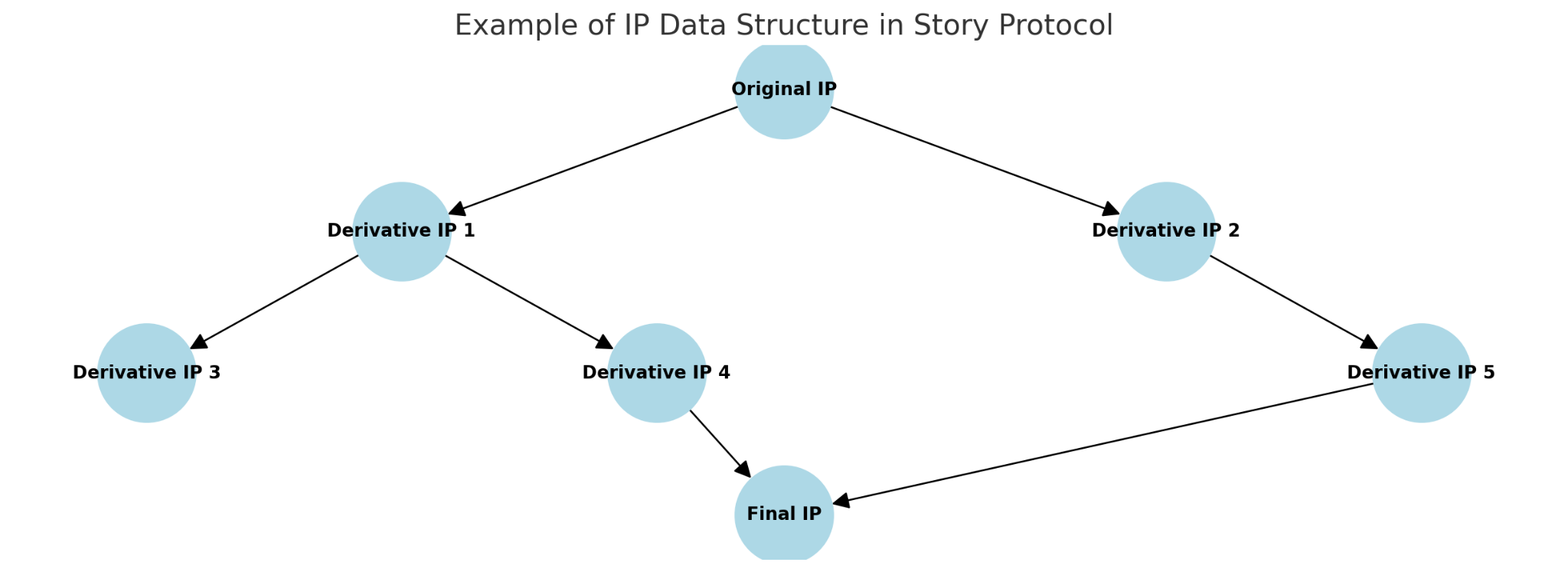
| EVM Updates(Shoham) | (i) Story uses storage slots [REF 2] to efficiently manage complex data, like IP relationship graphs, on Ethereum. By hashing key information, data is stored in unique, predictable slots, optimizing retrieval despite the high gas costs. (ii) Graph: Story’s ipgraph VM manages IP relationships as a graph, enabling the registration, retrieval, and tracking of parent and ancestor IPs. This graph-based structure is essential for creating an on-chain IP lineage, ensuring accurate attribution and royalty distribution. The approach addresses the inherent challenges and costs of maintaining complex graphs on the EVM.(iii) Royalty Management: The module includes functionality to set and retrieve royalties for IPs based on their parent-child relationships. This ensures that creators are compensated appropriately when their IP is used to create derivative works, maintaining a transparent and automated royalty system. [REF 5]In [Liquid Absolute percentage [REF6], the default royalty policy, there is an example of derivation chain showcasing the limitations (with story’s desired IP graph approach) |
|---|---|
| ERC-6551 | TA system which assigns Ethereum accounts to all non-fungible tokens. These token-bound accounts allow NFTs to own assets and interact with applications, without requiring changes to existing smart contracts or infrastructure. NFTs currently lack the ability to act independently or manage other on-chain assets. They cannot represent complex real-world items e.g, a game character with evolving abilities, a car made of various components, or an investment portfolio of multiple assets. This proposal aims to give NFTs the same rights as Ethereum users, enabling them to self-custody assets, execute operations, control accounts, and function across multiple chains. This is achieved by creating a registry that assigns a unique smart contract account to each NFT, permanently binding it to the NFT and controlled by its holder. |
| License | (Legal Contract) Similar to YC’s SAFE, Programmable IP License (PIL) is a customizable, universal license that bridges real-world IP with its on-chain tokenization. Similar to how fiat backs USDC, PIL secures IP on the blockchain, enabling easy, permissionless licensing and commercialization. It integrates closely with Story’s smart contracts, enforcing terms transparently and autonomously. Creators can set and attach PIL terms to their IP assets, making the process seamless for both Web3 and Web2 services. Note: Inspired by Cornell Prof James Grimmelman’s Token-Bound NFT License (link, REF 2). The module facilitates the creation of licenses by allowing users to define the terms and conditions under which their IP assets can be used. Once a license is created, it is tracked within the system, ensuring that all rights and restrictions are monitored. Users can also update or modify licenses as needed.Enforcement is a key part of the module, helping to ensure that the terms of each license are followed. If there is a breach or misuse of the IP, the module can enforce penalties or take corrective actions. This may include conducting audits to verify compliance.Additionally, the module handles the renewal and termination of licenses. Licenses can be renewed based on the terms set in the agreement, and they can be terminated if they expire or are canceled for any reason.) |
|---|---|
| Royalty | The Royalty Module defines how revenue flows between parent and child IP Assets. Revenue can flow in two main scenarios: (i) Minting a License: A fee is paid to mint a license from an IP Asset, with revenue flowing up the chain to parent assets. IP assets without parents can mint licenses using different royalty policies.(ii)Tipping Directly: Revenue sent directly to an IP Asset also flows up the chain to parent assets. e.g : If IP Asset 5 (IPA5) mints a license from IP Asset 4 (IPA4) for $1 million USDC, revenue flows to IPA1 and IPA2, the ancestors of IPA4, according to their agreements. The core programmable IP metadata on Story is an on-chain ERC-721 NFT. Existing NFTs like Azuki or Pudgy Penguin can register directly, no wrapping is needed and each ERC-721 token is unique, representing a specific IP asset with distinct metadata. For off-chain IP, you first mint an ERC-721 NFT, then register it as an IP Asset. Each IP Asset has an associated IP Account, a modified ERC-6551 contract, which controls permissions and stores related data. |
| Dispute | Dispute module manages conflicts over IP assets using a clear arbitration process. If there’s a disagreement, it’s resolved based on set rules. In the beta version, disputes are handled internally by the protocol team, with fees that may be refunded if the dispute is resolved successfully. Future updates might involve third-party arbitration services. When an IP is found to be infringing, it faces penalties like being unable to create or use licenses and cannot connect to parent IPs. Infringement tags, such as "PLAGIARISM," are applied to mark the IP. Anyone can start a dispute by choosing a tag, providing evidence, and following the arbitration rules. Only authorized parties can make a final, unchangeable decision. If an IP is deemed infringing, all its derivatives automatically receive the same tag.If the original IP’s issue is resolved, the tag can be removed from both the original and its derivatives. Disputes can be canceled before a final decision is made, but fees might not be refunded.In short, the module ensures that IP conflicts are resolved fairly, with penalties and tags applied to maintain the integrity of the IP system. |
Questions
-
Full Market Risk writeup / Tweet thread: [DUSTIN] Story’s FAQ example pre-supposes the possibility where Azuki and Pudgy NFT holders can register their assets as IP Assets, then commercially exploit them. But both Azuki and PP explicitly do not allow this in their licensing agreements, and it's likely all NFT collections will have similar terms and conditions in place because they have valuable IP to exploit for themselves and their community
-
But this is not what Azuki states in their NFT license agreement: When you acquire an Azuki NFT, you own all personal property rights to the token underlying the Azuki NFT (e.g., the right to freely sell, transfer, or otherwise dispose of that Azuki NFT), but you do not own the associated artwork, brand, or other intellectual property associated with that Azuki NFT, except for the specific licensed rights set forth below.
-
Pudgy Penguins: PRIMARY OWNER MAY NOT USE THE NAME “PUDGY PENGUIN(S)” OR ANY PUDGY PENGUIN NAME, LOGO OR TRADEMARK, THE NAME OF ANY PUDGY PENGUIN CHARACTERS (AS APPLICABLE), OR ANY ANIMATION, CHARACTERS, THEMES OR OTHER MATERIAL RELATED TO THE CREATOR’S OWN DIGITAL CONTENT; AND AGREES THAT THIS PURCHASE OF THE PUDGY PENGUINS NFT DOES NOT PROVIDE ANY RIGHTS, EXPRESS OR IMPLIED, IN (INCLUDING, WITHOUT LIMITATION, ANY COPYRIGHTS OR OTHER INTELLECTUAL PROPERTY RIGHTS IN OR TO) THE PUDGY PENGUINS ASSOCIATED WITH THE NFT OTHER THAN THE LIMITED LICENSES GRANTED IN SECTION 3 AND 4 ABOVE. THE PRIMARY OWNER’S RIGHTS AND INTEREST IN ITS PUDGY PENGUINS NFT, ITS ASSOCIATED PUDGY PENGUINS, ANY DERIVATIVE PUDGY PENGUINS, AND ANY ART PROVIDED BY THESE TERMS WILL IMMEDIATELY TERMINATE UPON ANY SUBSEQUENT SALE, TRANSFER, DISPOSSESSION, BURNING, OR OTHER RELINQUISHMENT OF THEIR PUDGY PENGUINS NFT. ANY USE OF THE ART OTHER THAN AS EXPRESSLY AUTHORIZED HEREIN, WITHOUT THE PRIOR EXPLICIT WRITTEN PERMISSION OF THE CREATOR, IS STRICTLY PROHIBITED AND SHALL IMMEDIATELY TERMINATE THE RIGHT TO ACCESS AND USE THE PUDGY PENGUINS WEBSITE (AS DEFINED IN PUDGY PENGUINS TERMS OF SERVICE) AND ALL RIGHTS AND LICENSES GRANTED BY THESE TERMS. SUCH UNAUTHORIZED USE MAY ALSO VIOLATE APPLICABLE LAWS INCLUDING COPYRIGHT AND TRADEMARK LAWS AND APPLICABLE COMMUNICATIONS REGULATIONS AND STATUTES.
-
Story Protocol is targeted at creators, but disruption of established actors in media have not come from the ground up, it has come from establishing a dominant platform that disrupts the established powers by improving the user experience significantly (Spotify streaming versus CDs by record labels, Netflix streaming versus Blockbuster rentals, then originals versus Hollywood Studios). The current Story Protocol plan addresses the creator economy but not how they outcompete existing platforms on any compelling measure to acquire users.
-
In lieu of outcompeting an incumbent, you can create your own category. Story Protocol will attempt to do this for AI generated content,
-
This is not easy, but it's easier than taking on incumbents with Lindy and vested interests in self preservation
-
Tech has been the most successful lever in this
-
AWS>Bare metal Data centers and webservices
-
Uber>Ride hailing
-
Airbnb>Vacay rentals
-
Flexport>Shipping
-
In general, tech has done so by disintermediation of the middle man by a software platform, and making that software platform free/value for money such that all parties join the platform
-
Once dominance is assured or competition is dead, the platform can start to extract value
-
But web3 is less performant than tech, decentralization means we move slower than a centralized tech company with a strong team and good execution
-
What does web3 do better than tech?
-
Dominant tech companies almost exclusively extract from their users once they establish dominance, whether it's raising fees or exploiting their data
-
Users stay because they're locked in
-
Dominant blockchains on the other hand have stickiness because users want to stay
-
Open source is a norm, a bad project with inequitable terms is liable to vampire attacks on community, or a hardfork that fits community alignment
-
Projects have a raison d etre that users align with, values based participation, as opposed to lock-in
-
Story needs to compete on equitable outcomes for content originators and IP partners (Netflix had to do this when they became a studio, and did this by paying content creators extremely well upfront, with the tradeoff that Netflix would not pay longtail viewership based royalties)
References
- Docker Compose: https://github.com/storyprotocol/node-utils/blob/b2c92d20873ebea13b5ef0070c149e16b4afceb8/story-node-docker/docker-compose.yaml
- Contract: https://github.com/storyprotocol/protocol-core-v1/blob/main/PIL_Beta_Final_2024_02.pdf
- Token Bound NFT License: https://james.grimmelmann.net/files/articles/token-bound-nft-license.pdf
- ERC-6551: https://eips.ethereum.org/EIPS/eip-6551
- EVM Code Changes: https://github.com/ethereum/go-ethereum/compare/master...storyprotocol:story-geth:main#diff-982e5903b0d47853971af41399f777f70c98a89e526df06abd57adce3a2ee514
- Documentation: https://docs.story.foundation/docs/what-is-story
- Liquid Absolute Percentage https://docs.story.foundation/docs/policy-liquid-absolute-percentageMaybe we can define IP here. I think when we think of IP like... just media things (cartoons, azuki art etc) it doens't make as much sense -- but when you think of IP like symbols, phrases, words etc, i think there's more potential in the ideaHmm good idea! We should raise this!Agree on this! It does feel like the IP term is used very loosely, maybe it could be interesting to brainstorm which IP categories could be the lowest hanging fruit.Good idea
Intellectual property (IP) law is a crucial area of legal practice that governs the protection of creations of the mind. It matters significantly for several reasons:
Definition and Scope
Intellectual property law deals with the rights of creators and owners of inventions, designs, brands, artistic works, and other intangible assets. It encompasses several key areas:
Patents: Protect new inventions, products, and processes
Trademarks: Safeguard brands, logos, and distinctive signs
Copyrights: Cover artistic and literary works, music, and software
Trade secrets: Protect confidential business informationEr, could we say this in a more PC way - i.e. a group of hype mods creating hype vibes ...?
Challenges of handling Royalties in Ethereum today as we seen in NFT - below argue "Royalties not enforceable in fully trustless / on-chain manner"
https://0xfoobar.substack.com/p/on-royalties
-
Most existing solutions rely on user/marketplace to opt-in (e.g. EIP-2891) / some centralized party
-
We know what happened during the opensea / blur war
-
Zora is a case study of enforce royalties at the chain level
https://zora.co/collect/oeth:0xa3744f9a5974bf59688d50e0d57402ff4bb41f83/3