| The WhitePaper Reading Club [29] | 22 July 2025 |
|---|---|
| MegaETH: WTF is REAL-Time? | Rongxin |
Summary
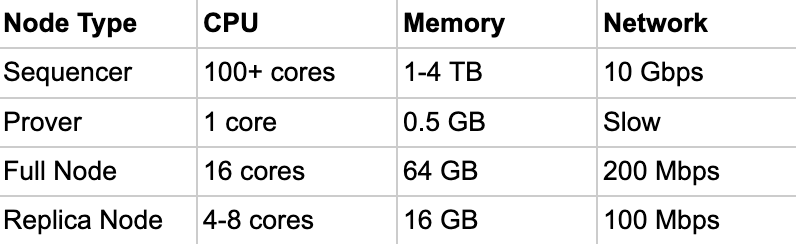
MegaETH separate consensus and execution roles. Uses specialized node types (sequencers, provers, full nodes, replica nodes) and optimizes hardware. It targets millisecond-level block times, million+ TPS potential, and multicore processing.
Key Innovation
New trie management, (ii) asynchronous proof-based replication, and (iii) builds on Ethereum security via EigenDA/EigenLayer while pushing EVM performance toward hardware limits.
Glossary
| EVM: EVM (Ethereum Virtual Machine): The runtime environment or "operating system" for Ethereum that executes smart contracts and processes network transactions. | Merkle Patricia Trie (MPT): A tree structure combining Patricia trie and Merkle tree to store key-value state for efficient data verification. | JIT (Just-In-Time) and AOT (Ahead-Of-Time): Compilation strategies to optimize smart contract execution. JIT compiles code during execution. AOT compiles code before execution for faster startup. |
|---|---|---|
| EigenDA: A system where EigenLayer lets projects rent security from Ethereum via restaking, and EigenDA is a specific data availability service that uses this shared security. | NOMT (Nested Ordered Merkle Trie): An optimized Merkle Patricia Trie that groups data into fixed-size pages for significantly faster data access and retrieval. | Block Gas Limit: A cap on the max amount of gas that can be consumed within a single block, acting as a throttling mechanism for network reliability. |
Team
Founders: (i) Yilong Li (CEO): PhD from Stanford, previously a Senior Software Engineer at Runtime Verification (ii) Lei Yang (CTO): PhD in distributed systems from MIT's Network and Mobile Systems group (iii) Shuyao Kong (CBO): ex-Global Head of Business Development at ConsenSys, Harvard MBA.
Team & Growth: Previously under 20 people, with recent funding allocated to expand the core development team and build out the ecosystem. Investors & Funding: Secured $20 million in a seed round led by Dragonfly Capital, with other backers including (i) VCs like Robot Ventures, Figment Capital, & Big Brain Holdings and (ii) angel investors such as Vitalik Buterin, Joseph Lubin, & Sreeram Kannan.
NFT Sale: A February 2025 community fundraiser featuring (i) 10,000 soulbound (non-transferable) rabbit NFTs sold for 1 ETH each (ii) which promised holders a future airdrop of at least 5% of the total MegaETH token supply.
Components
(Key Innovations - focus on the innovations, and key parts)
| Node Specialization | MegaETH splits network tasks into four node types: (i) Sequencers—high-end servers (100 CPU cores, 1–4 TB RAM) that process and order transactions for maximum speed; (ii) Provers—very lightweight nodes (1 core, 0.5 GB RAM) that validate blocks using stateless proofs; (iii) Replica nodes—mid-range machines (4–8 cores, 16 GB RAM) that apply state updates without re-executing transactions, reducing hardware and bandwidth needs; (iv) Full nodes—re-execute all transactions for finality and indexing. This design allows high performance (up to 500 million gas/second and under 10 ms block finality) while keeping most nodes lightweight for wide participation, compared to typical EVM chains (100 million gas/second, 1 second blocks). |
|---|---|
| Transaction Execution | MegaETH’s sequencer uses a custom, optimized EVM: (i) keeps the full 100 GB blockchain state in memory (RAM), eliminating slow disk reads; (ii) runs transactions in parallel, not one-by-one, for higher throughput; (iii) uses JIT (Just-In-Time) and AOT (Ahead-Of-Time) compilation for extra speed; (iv) schedules transactions based on dependencies, resolving conflicts on the fly and doubling parallelism from 2× to 4×; (v) accelerates compute-heavy cryptography (like keccak256) with 1.8× speedups. The system achieves 20,000 transactions per second during sync tests and consistently finalizes blocks every 10 ms, with custom gas metering to keep block limits safe. |
| State Sync | MegaETH syncs state efficiently using: (i) compressed state diffs (20× compression, 200 bytes per ERC-20 transfer), enabling 100,000 transfers/second over a 25 Mbps link; (ii) subtree packing and grouping to reduce storage operations from 6 million to 600,000 per second; (iii) a pipelined sync protocol using four threads for transmission, verification, and state updates; (iv) a trie engine that batches hashing, uses partial Merkle trees, and caches the top 24 levels for ultra-fast access. Benchmarks on a 1 TB state achieve 50,000 leaf updates/second, with projections of 300,000 with further optimizations. |
| State Root & Commitment Updates | MegaETH improves on Ethereum’s data structure by: (i) using a shallower, more efficient tree (radix-32 trie with Merkle ranges), reducing the steps needed to verify updates; (ii) grouping updates to process many changes at once; (iii) providing frequent, fast updates to the blockchain’s “root hash,” enabling lightweight clients to securely check the network with minimal effort. This results in much faster confirmation times, cutting delays from 10 milliseconds per block to under 1.5 milliseconds on powerful hardware. |
Competition
MegaETH vs. Monad: MegaETH focuses on maximizing speed through a single, centralized sequencer, while Monad parallelizes execution but requires high-end hardware for all validators to maintain decentralization.
MegaETH vs. Solana & Aptos: Unlike Solana and Aptos, which are standalone L1s with independent security, MegaETH operates as an L2 on Ethereum—offering Solana-level performance while benefiting from Ethereum’s security, liquidity, and developer ecosystem.it is called SALT. check out the first talk here https://www.youtube.com/live/aClwx7frNRgboth MegaETH and Moand parallelize execution