Lagrange: Robust Double Auctions for Resource Allocation
WPRC-017· DevCon· 2024. 11· INFRASTRUCTURE
Lagrange: Robust Double Auctions for Resource Allocation
The Prover Network Mechanism Design introduces an efficient double auction system for allocating computational resources in zero-knowledge-proof markets, ensuring fair access and maximizing affordability and profitability in a truthful auction.
The Prover Network Mechanism Design introduces an efficient double auction system for allocating computational resources in zero-knowledge-proof markets, ensuring that bidders get fair access to the computing power they need and both buyers/sellers of computing power maximize their affordability/profitability in a truthful auction.
Why This Is Important
ZK proofs are the core infrastructure of blockchain scaling projects. DARA solves the complexities of the decentralized proof market by enabling both proof requesters (bidders) and provers (distributors) to achieve maximum results in a truthful auction. It is the first mechanism that hits the sweet spot between truthfulness, strategy-proofness, and computational efficiency. DARA sets a new standard for resource allocation for decentralized prover networks, making truthfulness the best strategy for both buyers and sellers. By aligning the interests of the proof requesters and the provers, ensuring authenticity enables a true incentive-aligned marketplace that was previously unattainable.
Key Innovation
The core innovation lies in adapting a double auction mechanism to a knapsack setting, where bidders have all-or-nothing computational needs. This mechanism must remain truthful, weak group strategy-proof, budget-balanced, and computationally efficient.
Overview
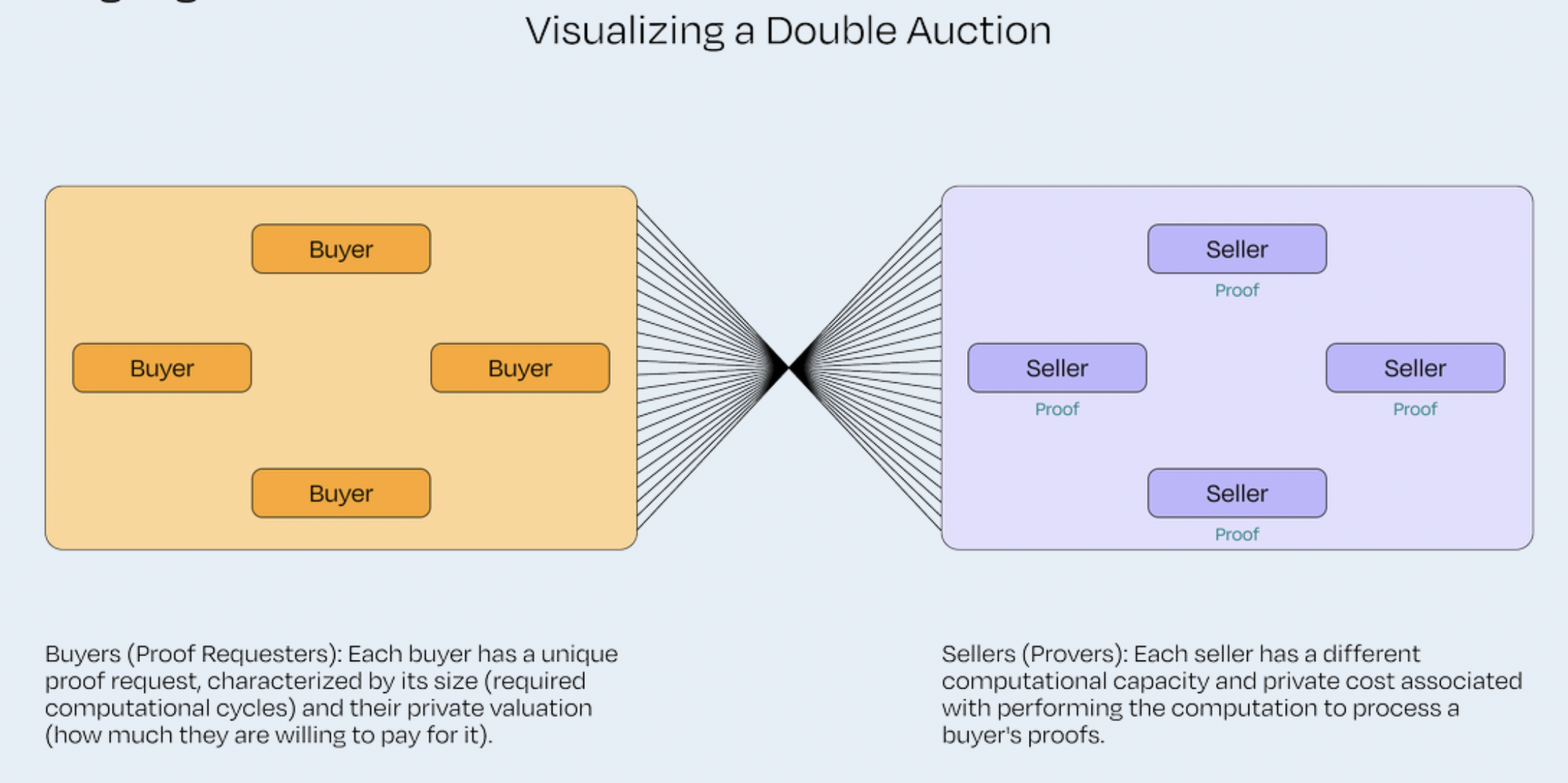
The proof-requesters (bidders) submit their requests, specifying how many computational cycles they need and their private value for completing the proof. Provers (distributors) submit their available compute capacity and private value per compute cycle. Both buyers and sellers are then ranked based on their private values with an algorithm that favors higher-value bids (from proof-requesters) and lower cost per cycle of compute (from provers). With these rankings, DARA mat ches as many buyers and sellers as possible, ensuring that the most efficient matches are made. This mechanism is similar to the call auction at the opening or closing of a stock transaction, which refers to a one-time centralized auction for the purchase and sale declarations received over a period of time.
图像
The Prover Network Mechanism Design addresses the need for a fair allocation of computation resources in the context of zero-knowledge proof (ZKP) markets. It introduces a double auction mechanism where bidders (those needing ZKP computation) and distributors (those offering compute cycles) are matched by an auctioneer who also sets the final price. The mechanism is designed to be robust, satisfying several important properties such as truthfulness, approximate welfare maximization, and weak budget balance, all while ensuring efficient computation. By using a modular and approximate approach, the auction can allocate resources effectively, even with the complex "all-or-nothing" demands of bidders.
Background
The traditional auction mechanism is one seller, with many buyers bidding, and the highest bidder wins. However, in a ZK Prover market, there are multiple buyers and sellers simultaneously, and the seller receives the limitation of computing power, so the traditional auction mechanism cannot meet the complex application scenarios needed for ZK prover markets.
Double Auction: A market setup where two sides (bidders and distributors) submit offers and an auctioneer matches them to determine trade outcomes and prices.
Knapsack Constraint: In a double auction, the bidder cannot accept less than k units of computation because their proof requires that exact amount to be completed. It's an "all-or-nothing" situation.
Truthfulness: Participants are best served by reporting their true values to the auctioneer, avoiding strategic bidding.
Weak Group Strategy Proofness: The system prevents groups of participants from colluding to improve their outcomes unfairly.
Weak Budget Balance: The auction mechanism ensures that the auctioneer does not lose money while facilitating trades, although it does not guarantee zero profit.
Welfare-Maximization: Across all possible assignments that satisfy the knapsack constraint, the auctioneer picks the ones with the largest sum of private values. The auction aims to allocate resources to maximize total benefit, or at least achieve a close approximation of the optimal solution
Computational Efficiency: The mechanism operates in polynomial time, making it feasible to implement even with a large number of participants and bids.
Team
Lagrange Labs, a zero-knowledge (ZK) startup, raised $4 million in a pre-seed round in May 2023 and $13.2 million in a seed round in May 2024. Lagrange Labs has launched a decentralized prover network to support a variety of protocols using different proof types. The first two protocols offered are the ZK Coprocessor (version 1.0 is now live, the first SQL-based ZK Coprocessor) and State Committees. The recent DARA paper was written by Arthur Lazzare, PhD Student in Computer Science at Yale University, Charalampos Papamanthou, Associate Professor of Computer Science at Yale, Co-director of Yale Applied Cryptography Laboratory, and Chief Scientist of Lagrange Labs, and Ismael Hishon-Rezaizadeh, Lagrange Labs Co-founder & CEO
Opinions
This is a unique way for auctions to align the incentives in proof marketplaces and improve the ZK landscape at large. It’s important to understand what properties make the double auction robust and how they are made possible.
Components
(Key Innovations - focus on the innovations, and key parts)
Knapsack Ranking Algorithm (for bidders)
Knapsack Problem: “Given a set of items, each with a weight and a value, determine which items to include in the collection so that the total weight is less than or equal to a given limit and the total value is as large as possible.”This algorithm sorts the bids submitted by bidders who need a fixed amount of computational resources. It prioritizes bids based on a combination of their value and required computation units, ensuring that higher-value bids with smaller computation requirements are ranked higher. Distributors (those offering computational resources) do not have this knapsack constraint. They can offer any amount of their available capacity.
Standard Ranking Algorithm (for distributors):
This algorithm sorts the bids submitted by distributors who offer computational resources. It typically prioritizes distributors based on their cost per unit, ranking those offering lower costs higher.
Composition Rule
A separate composition rule, which operates on pairs of bids and costs, helps determine whether a bidder-distributor pair should be accepted
Threshold Payments
Bidders pay the minimum amount necessary to secure their allocation, and distributors receive the maximum possible payment while still being included. This payment scheme encourages truthful bidding and prevents participants from manipulating the auction for their benefit.
Monotonicity and Consistency
The knapsack ranking algorithm must be monotone, meaning that a bidder's ranking should improve if they increase their value or decrease their size.The ranking algorithms must also be consistent. For bidders, this implies that a higher-ranked bid must have either a higher value or smaller size compared to a lower-ranked bid.These properties are crucial to guarantee the desirable characteristics of the auction, such as truthfulness and weak group strategy proofness.
Technical Aspects
The system works by first ranking bidders and distributors using their respective ranking algorithms. Then, it applies the asymmetric composition rule to select winning bidder-distributor pairs for the computational resources. After that, it performs trade reduction to eliminate the least efficient distributor, based on whether they have enough cycles for the bidders at a fair cost. Finally, the payment rule determines the final payments.
This modular design allows for flexibility in choosing different ranking algorithms and composition rules based on the specific needs of the ZK-market. Ensuring these components satisfy the 4 properties that make a double auction robust achieves the framework that promotes fair and efficient resource allocation in zero-knowledge proof markets.
Questions: (i) How does the entanglement of rollups affect scalability and throughput compared to traditional L2 scaling solutions?
(ii) What are the practical challenges in implementing Shadow Contracts across multiple chains, and how does the protocol plan to address them?
(iii) How will zkMIPS scale with increasing transaction volume across entangled rollups?
In many resource allocation settings, particularly in online markets, there are scenarios where bidders require specific quantities of a resource and are not interested in partial allocations. Such bidders are termed knapsack bidders or single-minded bidders. On the other side of the market, distributors (or sellers) have resources available in varying quantities and are willing to sell any amount up to their capacity.
A prime example motivating this study is a zero-knowledge proof (ZKP) market. In this setting:
Bidders have computational tasks (circuits) of varying sizes and private valuations for having these proofs computed.
Distributors possess computational resources and have private costs associated with performing computations per unit cycle.
An auctioneer facilitates the matching between bidders and distributors, determining allocations and payments.
The challenge is designing a double auction mechanism that ensures:
Truthfulness: Participants are incentivized to report their true private values or costs.
Weak Group Strategy-Proofness (WGSP): No group of participants can collude to improve their outcomes without at least one member being worse off.
Weak Budget Balance (WBB): The auctioneer does not incur a loss from facilitating the auction.
Computational Efficiency: The mechanism operates in polynomial time.
Approximate Welfare Maximization: The mechanism achieves a welfare close to the maximum possible given the bids.
Traditional auction mechanisms, such as the Vickrey-Clarke-Groves (VCG) auction, either do not satisfy all these properties or are impractical due to computational inefficiency. This paper proposes a new framework for designing robust double auction mechanisms in knapsack settings, extending the composition approach introduced by Dütting et al.
The WhitePaper Reading Club + zkHub
Nov 10 2024
Lagrange: Robust Double Auctions for Resource Allocation
The Prover Network Mechanism Design introduces an efficient double auction system for allocating computational resources in zero-knowledge-proof markets, ensuring that bidders get fair access to the computing power they need and both buyers/sellers of computing power maximize their affordability/profitability in a truthful auction.
Why This Is Important
ZK proofs are the core infrastructure of blockchain scaling projects. DARA solves the complexities of the decentralized proof market by enabling both proof requesters (bidders) and provers (distributors) to achieve maximum results in a truthful auction. It is the first mechanism that hits the sweet spot between truthfulness, strategy-proofness, and computational efficiency. DARA sets a new standard for resource allocation for decentralized prover networks, making truthfulness the best strategy for both buyers and sellers. By aligning the interests of the proof requesters and the provers, ensuring authenticity enables a true incentive-aligned marketplace that was previously unattainable.
Key Innovation
The core innovation lies in adapting a double auction mechanism to a knapsack setting, where bidders have all-or-nothing computational needs. This mechanism must remain truthful, weak group strategy-proof, budget-balanced, and computationally efficient.
Overview
The proof-requesters (bidders) submit their requests, specifying how many computational cycles they need and their private value for completing the proof. Provers (distributors) submit their available compute capacity and private value per compute cycle. Both buyers and sellers are then ranked based on their private values with an algorithm that favors higher-value bids (from proof-requesters) and lower cost per cycle of compute (from provers). With these rankings, DARA mat ches as many buyers and sellers as possible, ensuring that the most efficient matches are made. This mechanism is similar to the call auction at the opening or closing of a stock transaction, which refers to a one-time centralized auction for the purchase and sale declarations received over a period of time.
图像
The Prover Network Mechanism Design addresses the need for a fair allocation of computation resources in the context of zero-knowledge proof (ZKP) markets. It introduces a double auction mechanism where bidders (those needing ZKP computation) and distributors (those offering compute cycles) are matched by an auctioneer who also sets the final price. The mechanism is designed to be robust, satisfying several important properties such as truthfulness, approximate welfare maximization, and weak budget balance, all while ensuring efficient computation. By using a modular and approximate approach, the auction can allocate resources effectively, even with the complex "all-or-nothing" demands of bidders.
Background
The traditional auction mechanism is one seller, with many buyers bidding, and the highest bidder wins. However, in a ZK Prover market, there are multiple buyers and sellers simultaneously, and the seller receives the limitation of computing power, so the traditional auction mechanism cannot meet the complex application scenarios needed for ZK prover markets.
Double Auction: A market setup where two sides (bidders and distributors) submit offers and an auctioneer matches them to determine trade outcomes and prices.
Knapsack Constraint: In a double auction, the bidder cannot accept less than k units of computation because their proof requires that exact amount to be completed. It's an "all-or-nothing" situation.
Truthfulness: Participants are best served by reporting their true values to the auctioneer, avoiding strategic bidding.
Weak Group Strategy Proofness: The system prevents groups of participants from colluding to improve their outcomes unfairly.
Weak Budget Balance: The auction mechanism ensures that the auctioneer does not lose money while facilitating trades, although it does not guarantee zero profit.
Welfare-Maximization: Across all possible assignments that satisfy the knapsack constraint, the auctioneer picks the ones with the largest sum of private values. The auction aims to allocate resources to maximize total benefit, or at least achieve a close approximation of the optimal solution
Computational Efficiency: The mechanism operates in polynomial time, making it feasible to implement even with a large number of participants and bids.
Team
Lagrange Labs, a zero-knowledge (ZK) startup, raised $4 million in a pre-seed round in May 2023 and $13.2 million in a seed round in May 2024. Lagrange Labs has launched a decentralized prover network to support a variety of protocols using different proof types. The first two protocols offered are the ZK Coprocessor (version 1.0 is now live, the first SQL-based ZK Coprocessor) and State Committees. The recent DARA paper was written by Arthur Lazzare, PhD Student in Computer Science at Yale University, Charalampos Papamanthou, Associate Professor of Computer Science at Yale, Co-director of Yale Applied Cryptography Laboratory, and Chief Scientist of Lagrange Labs, and Ismael Hishon-Rezaizadeh, Lagrange Labs Co-founder & CEO
Opinions
This is a unique way for auctions to align the incentives in proof marketplaces and improve the ZK landscape at large. It’s important to understand what properties make the double auction robust and how they are made possible.
Components
(Key Innovations - focus on the innovations, and key parts)
Knapsack Ranking Algorithm (for bidders)
Knapsack Problem: “Given a set of items, each with a weight and a value, determine which items to include in the collection so that the total weight is less than or equal to a given limit and the total value is as large as possible.”This algorithm sorts the bids submitted by bidders who need a fixed amount of computational resources. It prioritizes bids based on a combination of their value and required computation units, ensuring that higher-value bids with smaller computation requirements are ranked higher. Distributors (those offering computational resources) do not have this knapsack constraint. They can offer any amount of their available capacity.
Standard Ranking Algorithm (for distributors):
This algorithm sorts the bids submitted by distributors who offer computational resources. It typically prioritizes distributors based on their cost per unit, ranking those offering lower costs higher.
Composition Rule
A separate composition rule, which operates on pairs of bids and costs, helps determine whether a bidder-distributor pair should be accepted
Threshold Payments
Bidders pay the minimum amount necessary to secure their allocation, and distributors receive the maximum possible payment while still being included. This payment scheme encourages truthful bidding and prevents participants from manipulating the auction for their benefit.
Monotonicity and Consistency
The knapsack ranking algorithm must be monotone, meaning that a bidder's ranking should improve if they increase their value or decrease their size.The ranking algorithms must also be consistent. For bidders, this implies that a higher-ranked bid must have either a higher value or smaller size compared to a lower-ranked bid.These properties are crucial to guarantee the desirable characteristics of the auction, such as truthfulness and weak group strategy proofness.
Technical Aspects
The system works by first ranking bidders and distributors using their respective ranking algorithms. Then, it applies the asymmetric composition rule to select winning bidder-distributor pairs for the computational resources. After that, it performs trade reduction to eliminate the least efficient distributor, based on whether they have enough cycles for the bidders at a fair cost. Finally, the payment rule determines the final payments.
This modular design allows for flexibility in choosing different ranking algorithms and composition rules based on the specific needs of the ZK-market. Ensuring these components satisfy the 4 properties that make a double auction robust achieves the framework that promotes fair and efficient resource allocation in zero-knowledge proof markets.
Questions: (i) How does the entanglement of rollups affect scalability and throughput compared to traditional L2 scaling solutions?
(ii) What are the practical challenges in implementing Shadow Contracts across multiple chains, and how does the protocol plan to address them?
(iii) How will zkMIPS scale with increasing transaction volume across entangled rollups?
In many resource allocation settings, particularly in online markets, there are scenarios where bidders require specific quantities of a resource and are not interested in partial allocations. Such bidders are termed knapsack bidders or single-minded bidders. On the other side of the market, distributors (or sellers) have resources available in varying quantities and are willing to sell any amount up to their capacity.
A prime example motivating this study is a zero-knowledge proof (ZKP) market. In this setting:
Bidders have computational tasks (circuits) of varying sizes and private valuations for having these proofs computed.
Distributors possess computational resources and have private costs associated with performing computations per unit cycle.
An auctioneer facilitates the matching between bidders and distributors, determining allocations and payments.
The challenge is designing a double auction mechanism that ensures:
Truthfulness: Participants are incentivized to report their true private values or costs.
Weak Group Strategy-Proofness (WGSP): No group of participants can collude to improve their outcomes without at least one member being worse off.
Weak Budget Balance (WBB): The auctioneer does not incur a loss from facilitating the auction.
Computational Efficiency: The mechanism operates in polynomial time.
Approximate Welfare Maximization: The mechanism achieves a welfare close to the maximum possible given the bids.
Traditional auction mechanisms, such as the Vickrey-Clarke-Groves (VCG) auction, either do not satisfy all these properties or are impractical due to computational inefficiency. This paper proposes a new framework for designing robust double auction mechanisms in knapsack settings, extending the composition approach introduced by Dütting et al.