Whitepaper Reading Club @ SBC - August 5th, 2025 The Boundless Protocol
By @BrianSeong99
Summary
Boundless is a decentralized marketplace protocol by RISC Zero that transforms verifiable compute into a programmable and trustless commodity, enabling any application or chain to request zero-knowledge proofs through an open, incentive-aligned market.
Why This Is Important
ZK proofs are critical for scaling decentralized applications, but producing them at scale has required centralized infrastructure or complex integrations. Boundless addresses this infrastructure gap by introducing a unified protocol where any developer can request or provide proofs across chains. It commoditizes ZK compute, unlocks decentralized verifiable computation, and enables coprocessor-based applications with security, modularity, and flexibility.
Key Innovation
Boundless reimagines the ZK proving landscape through five core innovations: (i) Reverse Dutch Auctions: An automated price discovery mechanism for proof requests that rewards efficient, competitive provers while minimizing cost for requestors. (ii) Proof of Verifiable Work (PoVW): A cryptographic metering system embedded in the zkVM that reports CPU cycles spent, enabling trustless reward calculation. (iii) Verifiable Service Agreements (VSAs): Long-term SLAs enforceable by smart contracts that lock in proving capacity, hedging volatility for high-throughput users. (iv) Vaults and Points System: A staking and revenue-sharing mechanism where $ZKC holders lock tokens to accrue points redeemable for protocol fees. (v) Cross-chain Proof Settlement: Proofs can be posted and verified on any L1/L2 with minimal latency, supporting rollups, appchains, and modular coprocessors.
Glossary
(i) zkVM: A virtual machine that produces zero-knowledge proofs for arbitrary computation. Boundless uses RISC Zero’s RISC-V-based zkVM. (ii) PoVW: Embedded zkVM metadata that proves how much computation was performed (measured in cycles) without being forgeable. (iii) $ZKC: The native token for Boundless, used for staking, governance, rewards, and participating in protocol economics. (iv) Vault: A smart contract where $ZKC is locked to earn protocol revenue and participate in proving or governance. (v) Points: Non-transferable balances earned by vault stakers, used to claim proportional protocol fees. (vi) Spot Market: An open, on-demand proving system where requests are fulfilled via reverse auctions. (vii) Service Agreement: A long-term compute contract between requestors and provers, enforced trustlessly on-chain.
Background
ZK systems have become increasingly capable thanks to advances in zkVMs and general-purpose proving. Yet while circuits and proving stacks have evolved, the infrastructure to access proving capacity has remained fragmented. Teams must spin up centralized clusters, rely on trusted relayers, or build bespoke backends to get proofs into their systems.
RISC Zero’s zkVM democratized ZK by making it programmable in common languages (Rust, C++) using the RISC-V ISA. Boundless builds on this by creating an economic layer where proof generation is treated as a verifiable, priceable service. Rather than one-size-fits-all services, Boundless allows market dynamics to determine when, where, and how compute is allocated—across chains and applications.
Team
Boundless is developed by the RISC Zero team, a pioneering ZK company that created the first general-purpose zkVM based on RISC-V architecture. The team has a strong research pedigree and practical engineering experience. Boundless is led by Shiv Shankar (ssh_nkar), previously with Ava Labs, Coinbase, and Amazon. Alongside him, the RISC Zero team includes core engineers and cryptographers from the Bonsai and Zeth zkEVM projects. Their past innovations include Bonsai (a scalable proving service), Zeth (the first Type-0 zkEVM), and the foundational zkVM architecture that powers Boundless.
The Boundless launch represents a natural extension of the team's vision to commoditize proving as a trustless, programmatic primitive. Notably, RISC Zero has been deeply involved in open-source cryptographic tooling. The team is backed by early investors including Bain Capital Crypto, Geometry, and Galaxy Digital, and continues to contribute research and specifications to the broader ZK and modular infrastructure ecosystem.
Opinions
Boundless represents a new layer in the modular stack—verifiable compute coordination. While other systems have aimed to scale blockchains via execution environments, Boundless scales off-chain execution through verifiable delegation. Its reverse auction mechanism aligns incentives with availability and demand, while PoVW ensures fairness without trusting nodes or oracles. Compared to services like zkCloud and Sindri, Boundless prioritizes decentralization and extensibility over convenience. It's more complex to integrate but rewards users with flexibility and neutrality. For use cases like proving AI inference, generating rollup batches, or computing proofs from DA sources, this flexibility is essential. If the proving market can sustain itself and attract enough liquidity on both sides, Boundless may become the proving backbone for the modular Web3 stack—doing for compute what EigenLayer does for trust.
Components
| Reverse Dutch Auction (Spot Market) | Requestors define jobs and submit them to the marketplace with a price curve that increases over time. Provers evaluate the job off-chain and either race to fulfill it or lock it. Locking grants temporary exclusivity in exchange for a stake. Fulfillment yields a payment, while failure triggers slashing and fallback auctioning. |
|---|---|
| PoVW + Tokenomics | Each proof contains a verifiable measure of work (zkVM cycles). During each epoch, provers are rewarded in $ZKC proportional to their share of total cycles or fee volume—whichever is smaller. This design prevents gaming and balances value and effort. Unallocated tokens are burned, curbing inflation. |
| Vaults & Points | Participants stake $ZKC into per-chain vaults. Staked tokens earn non-transferable points, which can be burned to claim a share of the fees or unlock tokens. This creates a dynamic where liquidity providers and participants earn protocol yield. |
| Verifiable Service Agreements (VSAs) | For recurring or high-volume users (e.g., oracles, AI apps, zkRollups), service agreements lock in compute terms. If a prover defaults, requestors can enforce recourse or trigger fallback markets. Agreements are programmable and can be fractionalized and resold. |
| Proof Delivery and Aggregation | Boundless supports proof batching for efficiency. Multiple proofs can be aggregated and verified as a group. Proofs can be posted to any L1/L2 with a verifier—enabling wide composability with DA layers, rollups, and zk coprocessor apps. |
Process Flow
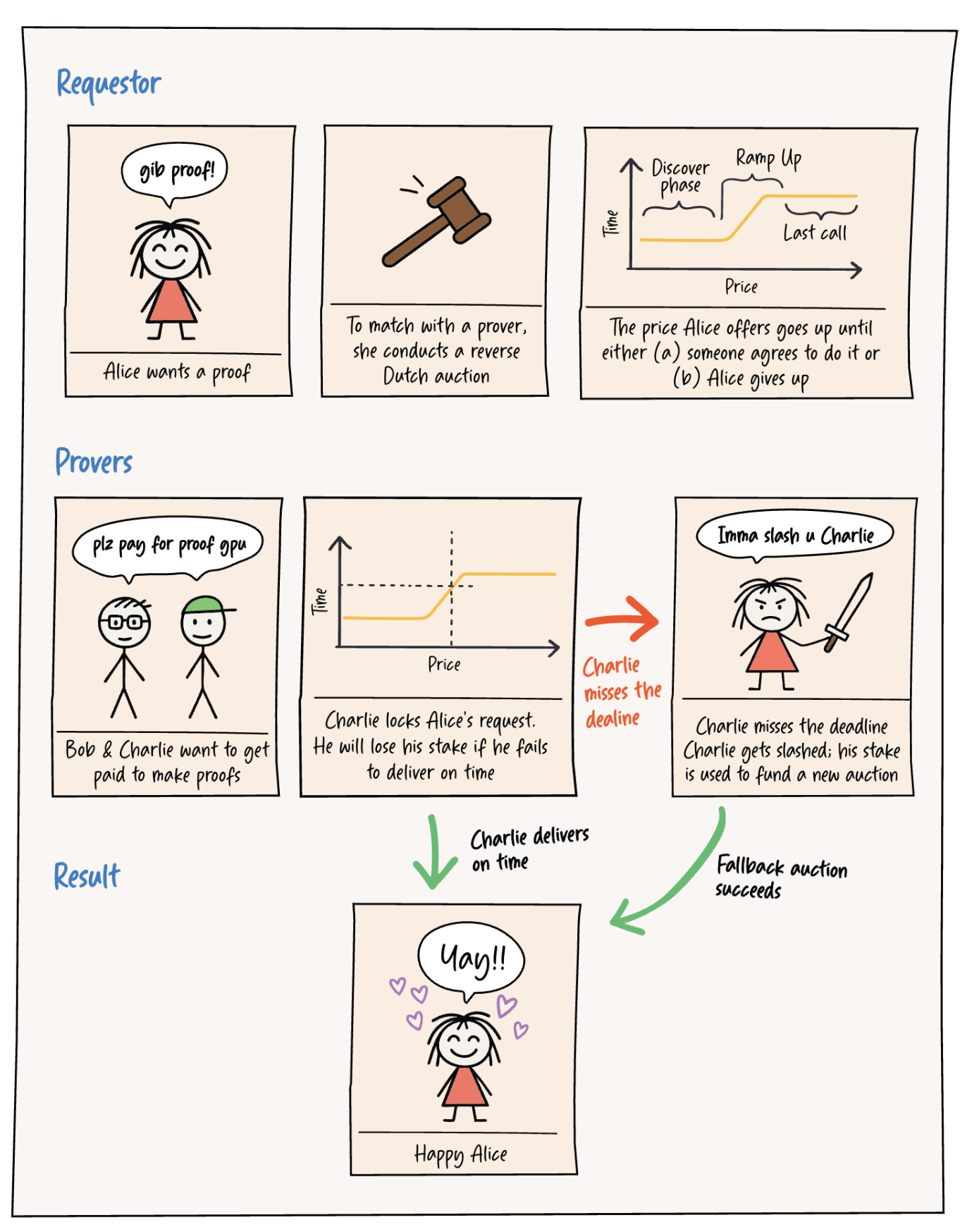
- Alice posts a proof job with metadata and a price function.
- Provers simulate execution off-chain to estimate effort and reward.
- Bob locks the job with stake, gains temporary exclusivity.
- Bob generates a proof with embedded cycle metadata.
- Bob submits the proof. He’s paid the current price minus protocol fees.
- The vault collects fees; Bob earns $ZKC rewards based on PoVW.
- Vault stakers accrue points and can claim their share of collected fees.
Questions
- What happens if requestors collude with provers to simulate work and drain rewards?
- Will latency-sensitive jobs (like oracles or games) adopt auction-based pricing?
- How does the system ensure fair fallback behavior when slashing occurs?
- Can PoVW be extended to other zkVMs (e.g. SP1, CairoVM) for broader compatibility?
References
- Boundless Whitepaper: https://read.beboundless.xyz/
- RISC Zero zkVM: https://github.com/risc0/risc0
- Zeth Type-1 zkEVM: https://github.com/risc0/zeth