| The WhitePaper Reading Club Singapore [27] - 13 May 2025 | |
|---|---|
| Bittensor: DTao + Mining + Infrastructure | |
| Too much ACID or an internet scale neural net? | Darren (Tensorplex), Rongxin (WPRC) |
Summary
“A new commodity needs a new type of market”. Inspired by the ability for Bitcoin to incentivize distributed compute (hashrates), Bittensor aims to do the same from the compute on intelligence. A bottom upm fractal approach.
Why This Is Important
Previously before dTAO - The emissions of TAO is controlled by validators who would assign weights to each subnet. Validators would act as the assessor previously to see if the subnet is valuable and has potential to grow. However, with the launch of dTAO - Stakers are able to directly purchase dTAO tokens which would increase the valuation of the subnet. The emissions are given out based on the market cap of the Subnet. Thus, dTAO introduces a free market to Bittensor where holders are able to invest directly in subnets they believe in.
Key Innovation
(i) Dynamic TAO makes subnet autonomous economies with their own alpha token, priced via an on-chain AMM backed by staked TAO. (ii) Yuma Consensus allows validators to subjectively evaluate miner performance and reaches agreement over emissions via a stake-weighted. (iii) On-chain incentive optimization, without requiring central authorities to judge AI quality. (iv) Mining PoW and PoS - Lots of miners in Asia focusing on this. Eth PoW people moving to here. Questions: Who are these people? Is it mostly the mining pools? What generation of GPUs are they using? Are there ASICs for this? (v) Data + Computation Privacy: Computing and discussion is privacy
| Glossary | Alpha Token (α): Subnet-specific token minted by staking TAO; local incentives | AMM: Constant product pool in each subnet for pricing α vs TAO. | |||
|---|---|---|---|---|---|
| Emission: Block by block TAO/α rewards based on performance and stake. | Halving Schedule: Emissions of TAO/α reduce over time until 21M max cap. | Metagraph: On-chain record of miner/validator states, weights, and ranks. | Miner: Node performing AI work; scored by validators; earns emissions. | Root (Subnet 0): No α; TAO-only staking to validators; subnet-agnostic. | Stake Weight: Validator’s influence = α stake + TAO stake × tao_weight. |
| Staking: Convert TAO → α; grants economic weight and emission share. | Subnet: Isolated AI marketplace with its own incentive model and α token. | Subnet Pool: Liquidity reserves (TAO, α); defines α price via AMM. | TAO (τ): Native token; used for staking, emissions, and weighting. | Tao Weight: TAO stake multiplier in validator influence calc. | Tensor: 3D Matrix? Google first to use such ideas e.g Tensorflow |
| UID: Unique ID assigned per subnet to registered miners/validators. | Unstaking: Convert α → TAO via subnet AMM; reduces influence. | Validator: Scores miners; submits weights to chain; earns emissions. | Validator Permit: need ≥1000 stake + top 64 slot to to commit weights, | Yuma Consensus: On chain algo; combines validator weights into emissions |
Background
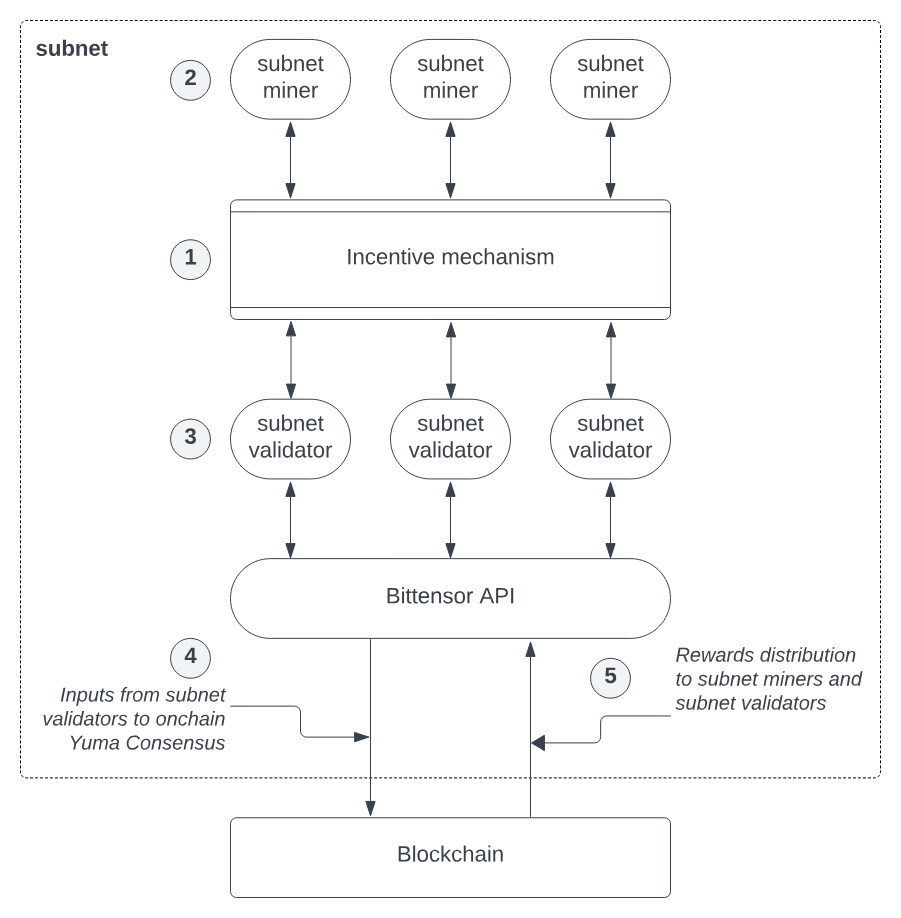
Bittensor aims to incentivize AI development using crypto markets, powered by a native token, TAO. Contributors can earn rewards for providing useful machine learning outputs, similar to how Bitcoin rewards miners for hash power. Its key innovations include: (i) open AI marketplaces where anyone can contribute models and earn based on performance, (ii) subnets—custom, composable mini-networks that define their own resource reward logic (e.g., compute, storage, intelligence), and (iii) Yuma Consensus, a novel consensus mechanism that enables probabilistic, subjective validation (critical for ranking AI outputs).
Opinions
(i) No concrete or easily discoverable subnet. (ii) Can’t easily verify the correctness of the project - too many jargons and complicated math. Either I’m the idiot or this guy’s an idiot. (iii) I wonder if subnets will face the same issue as Golem, FileCoin and Arweave? Ultimately all costs and infrastructure is determined by the large cloud providers? (iv) This reminds me of Circles from Gnosis - Sub communities.
Team
Founder of Bittensor (https://x.com/const_reborn): (i) Jacob Steeves, co-founder of Bittensor and known as @const_reborn, previously worked at Google Brain and Knowm. Since 2016, he’s led Bittensor’s architectural development. He also co-leads Rayon Labs, which operates Chutes (Subnet 64) for decentralized AI inference and Gradients (Subnet 56) for fine-tuning models. (ii) Yuma Rao is the pseudonymous creator of Bittensor’s Yuma Consensus and author of its whitepaper.
Components
(Key Innovations - focus on the innovations, and key parts)
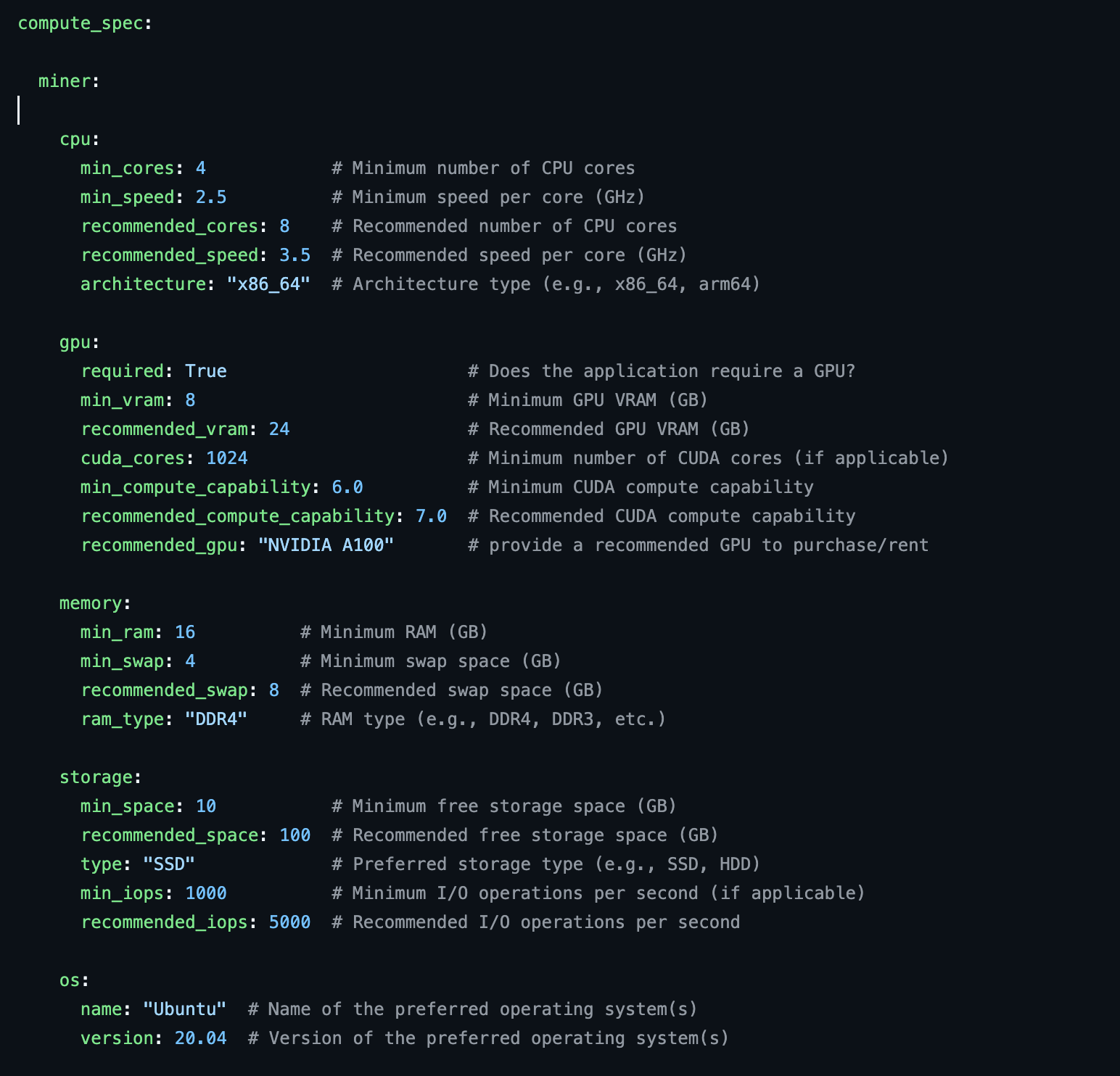
| Miners | Miners in a subnet are responsible for performing a task. For example, in the Chutes subnet, they are responsible for providing inferences. Miners would get rewarded depending on how well they perform a given task. Chutes is managed by Rayon (Bittensor’s team). Validators assign scores, which are aggregated by the on-chain Yuma Consensus algorithm to determine emissions. Example: In Subnet 64 (Chute), miners serve inference requests. Validators send prompts, score responses, and submit those scores to the chain. High-performing miners earn more TAO emissions.Disputes over performance are inherently resolved by Yuma Consensus through stake-weighted aggregation. Broader issues like protocol violations are handled via on-chain governance proposals voted on by the community.Being a miner means registering a hotkey to obtain a unique UID within a chosen subnet, where miners perform AI-related tasks defined by the subnet’s incentive mechanism. Validators assess the quality of miners’ outputs, and their evaluations are aggregated through the on-chain Yuma Consensus algorithm to determine TAO emissions distributed among miners, validators, and subnet creators. Each subnet operates as an automated market maker with its own alpha token, whose value is influenced by TAO reserves and participant staking. Miners must consistently deliver high-quality work to maintain their UID slots, as underperforming miners risk deregistration. Examples of Subnets:https://fxtwitter.com/Defi0xJeff/status/1915427721905398262Miner Specs: |
|---|---|
| Subnets | A specialized mini-network focused on a specific AI task e.g text generation, translation, or image recognition. Each subnet operates as a decentralized marketplace where miners (AI model operators) perform tasks, and validators assess their outputs. Participants are rewarded in TAO, Bittensor’s native token, based on performance. Key Points:Focus: Each subnet targets a specific AI function, enabling focused development and optimization.Questions: Can you copy an exact subnet? How does the incentives work for that?Incentive: Miners/validators earn TAO rewards proportionate to their contributions and performance within the subnet. Tokens: Subnets have their own tokens, called alpha tokens, which represent stake and influence within that subnet. These tokens are acquired by staking TAO and can fluctuate in value based on subnet performance.Governance: Subnets operate independently.Questions: Are Subnets just Layer2’s or Subnets in AVAX. How is the incentive aligned to TAO? Would this change if this exchange rate Opened up to be more than just AlphaToken:TAO? |
| Validator | Validators in a subnet are responsible for verifying the miner’s work and determine which miners have performed the best. This is done by assigning a trust score to the miner, which would determine how much emission a miner would receive. In return for performing these tasks, they would receive rewards.Validators send tasks (e.g., AI prompts), score responses, and submit these scores (weights) to the blockchain. Yuma Consensus aggregates these weights to determine emissions for miners and validators. To validate, one must: (i) Register a hotkey and receive a UID on the subnet. (ii) Hold a minimum validator stake weight. (iii) Be among the top 64 staked validators in the subnet. |
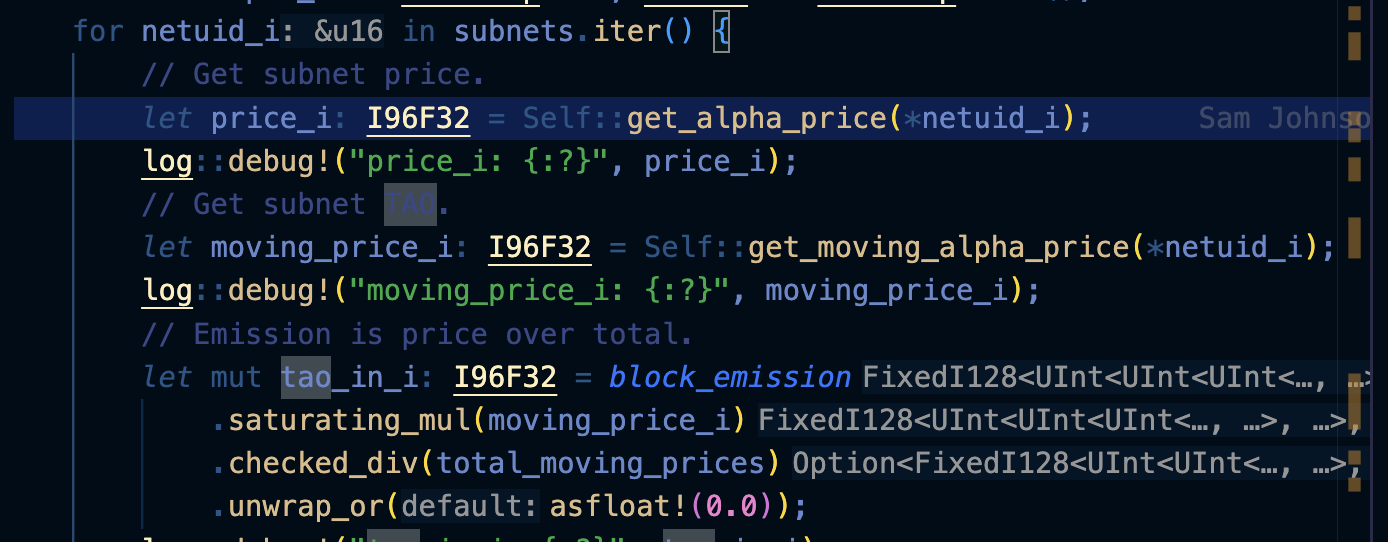
| Yuma Consensus | The consensus mechanism used to determine how much TAO tokens are being distributed to each subnet at each block. The amount of TAO injected in the subnet pool in each block is determined by the current subnet moving price / total moving price. Note: 1 TAO is being emitted in each block, so the calculator is = 1 * moving_price_i / total_moving_prices. Each Alpha token would have a FDV supply of 21 million with tokenomics the exact same as TAO where 1 Alpha would be emitted each block. However, the actual TAO or Alpha only gets distributed once every 360 blocks (1 epoch). Questions: (i) Are moving averages determined natively on the Bittensor chain? (ii) I don’t understand the “Subjective” parts of the consensus. |
| Alpha tokens | Native Bittensor subnet tokens. Each subnet would have its own Alpha token where users can swap TAO for Alpha token through a native substrate Uniswap V2 Pool (Native V3 Pool coming soon).There is the concept of both root stakers and alpha stakers. Root stakers are users that stake into validators in the root subnet while alpha stakers stake individually into the non root subnets. Alpha stakers get rewarded in Alpha tokens. However for root stakers, technically they are staking into every subnet since the root subnet has weights in every single subnet. This means that they would receive Alpha emissions as well. Internally, the Alpha they would receive would be automatically converted to native TAO each block. Thus, there would be sell pressure in each block as the Alpha is swapped into the pool in exchange for TAO. Note: This would mean that when a subnet is first launched, the liquidity would be very low at the start and increase over time as the alpha and TAO would be emitted slowly by the block. This can create speculation risk as traders may unknowingly buy into low liquidity pools and encounter high slippage.Questions: (i) How is the initial exchange rate between DTAO and TAO determined? |
Quotes
(i) “The art is the market.” OR can we say “the market is art” (ii) “ultimate subjectivity is flawed, as the most short‐term profitable strategy for Stake is to simply reward itself in isolation, a snake eating its own tail” (iii) “Similar to how a transformer's success fundamentally builds on enhancing adaptive space. So it is a core design principle to constrain local space to adapt minimally.” (iv) “Consensus before moving local weight into global weight”
References
- https://bittensor.com/whitepaper
- https://bittensor.com/content/consensus_v2
- https://bittensor.com/dtao-whitepaper
- https://docs.bittensor.com/Thank you @darren. I assume that moving averages are calculated natively through some mechanism on chain? e.g there's not "oracle"