The WhitePaper Reading Club Singapore [18]
Berachain Proof-of-Liquidity 9 July 2024
A new incentive layer for DApps or just more farming? JingYi, Eugene, Rongxin, Wesley [...]
Summary
EVM-identical blockchain with a unique Proof-of-Liquidity consensus mechanism to enhance security, scalability, and developer experience with built-in DApp mechanism incentive and governance tools.
Why This Is Important
It potentially solves the misaligned incentives between chains and protocols that build on them.
Community Opinions
Risks: (i) Large native DEX/lending platforms may monopolize Berachain’s ecosystem and rewards, requiring trust in Berafoundation to not do so. (ii) DApps with large token holdings could censor other applications since they participate in consensus.
(iii) The chain’s heavy reliance on its native stablecoin incentivizes risky behavior, potentially destabilizing the system if the stablecoin fails. (iv) There are doubts about the team’s background with Olympus DAO/OHM. The system resembles the 3,3 strategy, where users are incentivized to hold together for the best outcomes.
Interesting points:(i) Due to the PoL model, yield farmers may shrink as validators also become farmers. (ii) DApps are incentivized to launch their own tokens to bribe validators.
Questions
(i)Liquidity flow and token incentives remains confusing for most people. (ii) It’s unclear if developers are motivated by real innovation or just token rewards. (iii) “Proof of Liquidity” can be misleading since validation still uses a BFT protocol.
Opinions
(i) They are integrating grants and rewards for token projects directly into the protocol, unlike L1 networks that use VC or ecosystem funds. To prevent established protocols like Uniswap or Aave from monopolizing these rewards, they included basic protocols such as DEX, Perps, and Lending. This approach ensures every chain has essential features by default, like a house with basic amenities. It encourages innovation either on top of these base protocols or in entirely new projects.
(ii) They have developed tools like BeaconKit and OffChainSDK to simplify blockchain and DApp development. These open-source tools enhance the developer experience and are likely to see widespread adoption. This shows that the team excels not only in protocol engineering but also in application development, which is crucial for ecosystem adoption.
Key Components
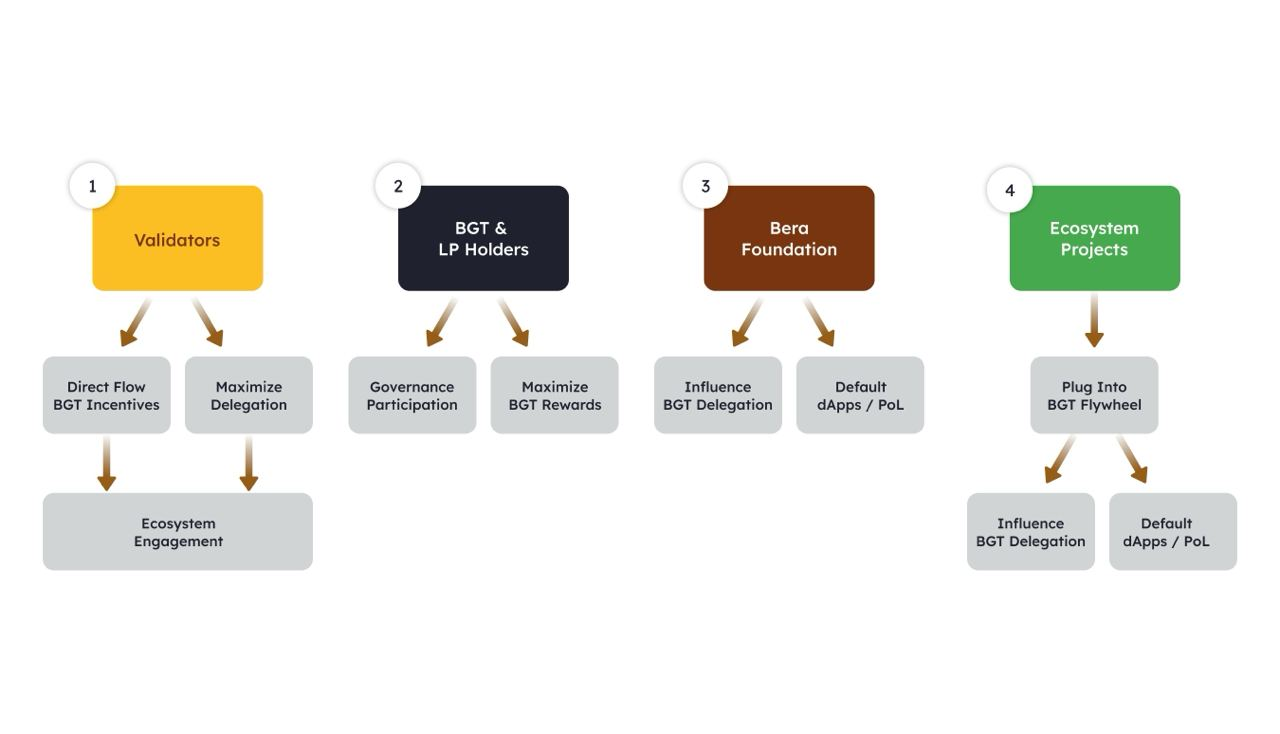
- Protocols deposit protocol incentives (a token) for Validators, into a Gauge. This Gauge tracks Users who provide liquidity and distribute $BGT.
- Validators stakes $BERA to have the right to produce blocks. They are rewarded with $BGT when picked to build blocks. Question: How is the weighting decided? $BGT amounts or? In V2, every validator has same chance of creating a block but reward is proportionate to the $BGT that was delegated to them.
- Validators are rewarded protocol incentives, based on how much value they return to the ecosystem.Question: value returned to what? In this case, the amount of security tokens staked to produce the next block.
- Validators vote to decide which gauges will receive the $BGT rewards, and in return Validators are rewarded native tokens.
- Users deposit LP tokens or carry out certain protocol actions to qualify for $BGT emissions
Proof-of-Liquidity (PoL)
PoL is an upgrade to the Proof of Stake consensus/security model. It splits governance and utility into 2 tokens $BERA (gas token) and $BGT (governance token). The aim is to boost the ecosystem’s liquidity, which translates to potential improvements in DeFi protocols e.g. higher LTV in lending markets, capturing more users. 3 user groups in BeraChain: Validators: People that are incentivised to secure the network with staking, Protocols: Applications incentivised to build on the network, Users: Incentivised to use the network because it has the best liquidity. POL Workflow:
Validators Incentives: Earn (i) Gas fees and priority fees (ii) $BGT can be burnt to create and vote on governance proposals (iii) Collecting incentives provided by Protocols for directing $BGT rewards to their gauges. Block’s proposing validator has the right to distribute the block’s $BGT rewards to any gauge they choose, and collect any associated incentives provided by protocol
Gauges
Are smart contracts for Users to deposit PoL-eligible assets to earn $BGT. The amount of $BGT earned is a function of (1) the Amount of $BGT emitted to the gauge, (2) Users’ share of total assets staked in the gauge. The incentive asset added to the gauge by Protocols needs to be whitelisted through a governance proposal. Berachain employs a Gauge Whitelisting process where protocols can submit proposals to create a new gauge for specific PoL-eligible assets. (3 incentive assets per gauge) Question: (i) Can these incentives be from different protocols? Not sure. For now, the example given in Berachain docs is for a single party to offer up to 3 incentives assets. (ii) BGT holders decide which projects can issue incentives. Will large protocols block proposals that are competitive with them? Possibly, but it is the same problem with most governance-token based voting. If sufficiently designed and decentralized, no large protocols will have veto power.
EVM Identical
(i) Uses the same execution clients like Geth, Reth, Erigon, and more. (ii) This allows Berachain to support the same set of tooling on Etheruem e.g. Metamask, indexers, etc.
Tokenomics (Tri-token Liquidity)
| $BERA | Gas Token: $BERA is used to pay for transactions on the Berachain blockchain, earning it the name “gas token.”Validator Activation Bond: Individuals or entities must stake a certain amount of $BERA to become validators. The total staked $BERA enhances the security of the chain |
|---|---|
| $BGT: | Distribution: $BGT is rewarded to direct delegators and specific liquidity providers (LPs). It is non-transferable and can only be acquired through validators.Governance Use: $BGT is used to vote on governance proposals, influencing which validators receive Berachain emissions. Holders can delegate their voting power.Burning for $BERA: $BGT can be burned at a 1:1 ratio for $BERA, Berachain’s native gas token.Slashing Policy: $BGT delegated to validators is not subject to slashing; only the validators’ $BERA is subject to slashing.Incentives: $BGT holders receive rewards from native dApps like Bex, Bend, and Berps, as well as fees from minting and redeeming $HONEY |
| $HONEY | Description: $HONEY is a fully collateralized stablecoin soft-pegged to the US Dollar.Minting Process: Users mint $HONEY by depositing whitelisted assets into specific collateral vaults. Each vault is tailored to a particular type of collateral, with unique mint and redemption rates.Governance: The minting rates for $HONEY are determined by governance, ensuring flexibility and control over the stablecoin’s supply and collateral requirements |
[Disgram to show token flow - Jing to add in] jingyitan1999@gmail.com
Contribution to Open Source Developer Tooling
| BeaconKit | Berachain V1 was built on Polaris, a monolithic framework where the EVM execution layer was tightly coupled with Cosmos consensus. This architecture was unable to support the amount of transactions that was received during the 1st testnet - Artio, and saw compatibility challenges in the code. Berachain V2 featured a switch to a modular framework that decoupled execution and consensus - validators would run the BeaconKit client for consensus, and an EVM execution client.Notes: This is the first large scale project that actually separated the consensus vs execution model. https://github.com/berachain/beacon-kit |
|---|---|
| Off Chain SDK | The Berachain Offchain SDK is an open-source framework designed to facilitate the development of off-chain services for Ethereum Virtual Machine (EVM) chains. It provides tools and modules for client-server interactions, job handling, logging, and configuration management, aiming to simplify and enhance the developer experience for creating scalable blockchain applications.https://github.com/berachain/offchain-sdk |
| CometBFT | CometBFT (fork of tendermint) is a high-performance, Byzantine Fault Tolerant (BFT) consensus engine designed for decentralized applications. It powers applications by ensuring secure and consistent state replication across distributed networks. Key features include fast finality, scalability, and robust security through its consensus algorithm. CometBFT quickly confirms transactions and scales well to handle many users, protecting against malicious activities. It works with different blockchain setups, making it versatile and reliable for developers creating decentralized apps. Notes: While this doesn’t seem to be developed by Berachain, it is an extremely interesting project for infrastructure projects.https://github.com/cometbft/cometbft + https://docs.cometbft.com/v0.37/introduction |
Comparisons/Competitors
All PoS based L1s / L2s?
Team
Smokey (CEO), PapaBear (Lead Dev), Cami (Community), MVP, Yogi - Most of the team from Canada & USA. Bong Bears - The Origin of Berachain’s DeFi-Heavy Roots Reference Investors: Series A - Polychain Capital, Series B - Framework
Other Questions (JingYi):
-
What are the pros and cons of having their own chain versus being just a DApp?.
-
POL allows Berachain’s validator set to drive block rewards to the protocols building in the chain, providing them with a sustainable economic mechanism to live on Bera, while decreasing CACs and improving capital efficiency.
-
In short, Berachain helps to accelerate the application layer, which is integral to crypto adoption over time and total “shots on net” for building useful things.
-
It seems that Berachain is bribery markets on the scale of a chain, where instead of Curve emissions, protocols are vying for Berachain emissions
-
This structure has however, been proven in the past that it does not benefit users eventually, evident from the price of Convex and their yield
-
Chicken and egg problem to incentivizing validators
-
The aim of PoL is to provide a new way for protocols to bootstrap liquidity through a sustainable approach, instead of having to incentivize through liquidity mining, which depletes the native token supply and leads to sell pressure. Co-author: Not sure if I agree with this, as Berachain definitely incentivize liquidity mining, and the governance token $BGT can either be used for governance or burned for $BERA. Not necessarily will lead to sell pressure as $BGT is not sellable (althought $BERA is).
-
Protocols that join the ecosystem later, which might not have ‘endorsements’ from the Berachain team, will face the question of how to incentivize deposits in their gauges, when they have yet to start collecting $BGT. Will this result in a situation where they have to fork out their own protocol token as incentive - which then falls back to the original problem of sell pressure. Co-author: This is a real problem, and the whitelisted process by the team is probably not going to be very transparent.
-
In addition, protocol incentives (which consists of native protocol tokens) will be issued to validators, which still contributes to the selling pressure of the protocol’s native token
-
What are the potential parameters that are involved in determining the kind of incentive assets that can be added into the gauge?
-
If a whale comes in with excessive amount of $BGT and incentive assets for gauges, they can effectively incentivize validators to direct $BGT emissions to his gauge, and receive a large sum of $BGT due to his ability to take up a large sum of the gauge’s asset proportion, proceed to convert to $BERA, and sell, causing a price crash in $BERA, which is the asset used to secure the chain. Co-author: Agreed that this could happen. However, $BGT cannot be bought so the whale will have to provide tonnes liquidity over a long period of time to the right pools and competing with various other whales to earn massive amount of $BGT.
Question: Is this just another DeFi-yield farming opportunity, or will automated monetary incentives drive product and technical innovation? Does injecting more money into the ecosystem enable more long term innovations, or simply attract short-term participants?
Rating
-
Does it benefit token holders, early VCs, or Builders?
-
A balance of all 3 most likely, as
-
Token holders can earn yield by providing liquidity
-
Early VCs get their vested bags
-
Builders earn yield from building on Berachain
-
Does it benefit the overall web3 ecosystem?
-
Berachain offers an innovative consensus mechanism, but @storysylee thinks it is just a bootstrapping gimmick hence not value adding to the web3 ecosystem https://x.com/storysylee/status/1810741771845939298
-
Does it enable more people to come into web3?
-
Berachain does attract outsiders/builders from other industries to join Web3, case study being an upcoming vape-to-earn project (PuffPaw). However, there are no new non-Defi (and hence non-crypto-facing) DApps built on Berachain that cannot be built on other chains.
Resources + Links
https://www.youtube.com/watch?v=hJhXdr7fasw&ab_channel=HackSummit
Notes
8 million unique wallets
NFTs / Defi Summer - consuming cannabis
NFTs of bears smoking weed.
Rebasing NFTs
In-depth Summary of Part (i) from Paper: Focused on the ideas and problems discussed and less on the summary of AI/ML.
Ecosystem Part (Rongxin)
Protocols
This website shows an extensive list of projects in the Berachain ecosystem: link
- Infrared - main on from their ecosystem. And then see if (Build a Bera Academy)
- Gummi
- Kodiak
- Beraton
Ecosystem Growth
- Berasearch
- Build-a-BeraWhat is the LP Token?Liquidity pool token (e.g. $BERA/$HONEY), once you stake it you get BGT rewards